12 Beginner Gardening Tips for a Beautiful Garden
If you’re new to gardening, knowing where to begin can sometimes feel harder than the gardening itself. These beginner gardening tips will help you get to know your garden, choose plants more likely to thrive, and tackle the basics without feeling overwhelmed.
Gardening can look wonderfully easy when you watch someone who has been doing it for years. They wander around with a pair of secateurs, casually snip something here, pull something out there and somehow end up with a beautiful garden.
When you’re a beginner, it can feel rather different.
Which plants are weeds? Why is that one drooping? Does this one need feeding? How often should you water? And what exactly are you supposed to do with the enormous shrub that’s apparently trying to take over the shed?
The good news is that gardening doesn’t have to be complicated. These beginner gardening tips will help you learn your garden gradually, avoid some common mistakes and, most importantly, enjoy what you’re doing.
You don’t need to know everything before you start. Gardens are remarkably good teachers.
(As an Amazon Associate, I will earn a small commission from qualifying purchases at no extra cost to you.)
1. Start Small
One of the easiest beginner gardening mistakes is trying to transform the entire garden at once.
Don’t.
Choose one flower bed, a few pots or one small corner and concentrate on that first. You’ll quickly discover which jobs you enjoy, which plants thrive and how much time you realistically want to spend gardening.
A small area that looks lovely is far more satisfying than six half-finished projects staring accusingly at you every time you open the back door.
2. Get to Know Your Garden Before Changing It
If you’ve moved into a home with an established garden, resist the temptation to immediately pull everything out.
Give it some time.
Plants that look thoroughly unimpressive during autumn or winter can suddenly produce beautiful flowers in spring and summer.
Watch where the sun falls during the day too. Some areas may receive sunshine for hours while others remain shaded by fences, buildings or trees.
Knowing which areas are sunny, shady, sheltered, damp or dry makes choosing suitable plants much easier.
3. Find Out What You’ve Already Got
This can be one of the most enjoyable parts of inheriting a garden.
Instead of seeing an unidentified green blob, start discovering what’s actually growing there.
Keep plant labels whenever you buy something new and, if possible, make a simple note of where you’ve planted it.
A Gardening Book Is Worth Having
Apps are handy, but there’s something reassuring about having a good gardening reference book nearby.
For a beginner, I’d particularly look for one with clear plant photographs or illustrations, identification help and straightforward care advice.
A useful reference can help answer questions such as:
- What is this plant?
- Does it prefer sun or shade?
- How much water does it need?
- When should I prune it?
- How large will it eventually grow?
- Is it hardy enough to stay outside over winter?
If you’re completely stumped by a mystery plant, the RHS Grow tool can help identify plants from a photograph and provides useful growing and care information too.
You certainly don’t have to memorise hundreds of plant names. You’ll naturally start recognising your favourites surprisingly quickly.
Smart Buy Guide Pick: We highly recommend this RHS plant identification and care gardening book
4. Follow the “Right Plant, Right Place” Rule
You can give a plant enormous amounts of love and attention, but if it’s planted somewhere it hates, you’re going to have an uphill battle.
A sun-loving plant placed in deep shade may struggle. Likewise, a plant that likes well-drained soil won’t appreciate sitting permanently in soggy ground.
Before buying a plant, check its label for:
Sun – Partial Shade – Shade – Soil – Ultimate Height – Ultimate Spread – Hardiness
That last pair is particularly useful. The innocent-looking little shrub in the garden centre may have ambitions to become enormous.
Choosing plants suited to the conditions you already have is much easier than constantly trying to change those conditions.
5. Learn a Little About Your Soil
You don’t need a laboratory coat.
Start by simply looking at and feeling your soil.
Does it stay wet and sticky after rain? Does water disappear almost immediately? Is it dark and crumbly, heavy and clay-like, or light and sandy?
Different soils hold water and nutrients differently, and some plants are much happier in particular conditions.
You can also buy an inexpensive soil pH testing kit if you want to know whether your soil is acidic, neutral or alkaline.
Don’t worry about achieving “perfect soil”. The aim is to understand what you’ve got so you can choose plants that are likely to enjoy living there.
Smart Buy Guide Pick: If you’re never quite sure whether a plant needs watering, a digital soil meter can take some of the guesswork out of it. This 3-in-1 model checks moisture, soil pH and temperature, which makes it particularly useful when you’re still getting to know your garden. A multi-function soil meter can also give beginners a quick indication of pH without needing a separate testing kit.
6. Beginner Gardening Tips for Better Watering
This is a wonderfully easy mistake to make.
Plant looks miserable.
Beginner gardener sees miserable plant.
Beginner gardener reaches immediately for watering can.
But a drooping or unhappy plant doesn’t automatically mean it’s thirsty.
Check the soil first. Push a finger into compost in pots, or use a small trowel to check below the surface of beds and borders.
When watering is needed, a good thorough drink is generally better than repeatedly wetting only the top of the soil. Aim the water towards the base of the plant so it reaches the roots rather than simply soaking the leaves.
And remember that newly planted flowers, shrubs and trees usually need more attention while they’re establishing themselves.
If watering is something you struggle to keep on top of, our Garden Watering Gadgets guide has some useful ideas for making the job easier.
7. Buy a Few Good Tools, Not an Entire Shed Full
Garden centres contain some fascinating gadgets, and it’s remarkably easy to convince yourself you desperately need all of them.
You don’t.
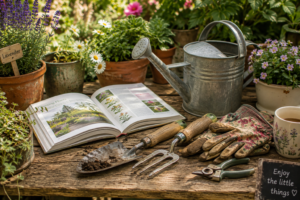
For most beginner gardeners, a small collection will tackle an enormous number of jobs:
- Hand trowel
- Hand fork
- Secateurs
- Gardening gloves
- Watering can or hose
- Spade
- Garden fork
Smart Buy Guide Pick: A good pair of secateurs is one of the garden tools I reach for again and again. I use these small Spear & Jackson secateurs myself and love them — they’re a simple, useful choice for everyday pruning and tidying around the garden.
Buy more specialised tools when you discover that you genuinely need them.
A comfortable pair of gloves is particularly worthwhile. Gardening is considerably less charming when you’ve discovered the nettles with your bare hands.
Once you’ve mastered the basics, you might also like our Autumn Gardening Gadgets guide for a few useful tools and ideas to make seasonal garden jobs easier.
8. Choose Some Forgiving Plants
One of my favourite beginner gardening tips is to choose plants that don’t demand constant attention.
Your first plants don’t need to be rare horticultural treasures requiring the gardening equivalent of room service.
Choose plants that are known for being relatively straightforward.
Depending on your garden’s conditions, possibilities might include lavender, hardy geraniums, sedum, heuchera and many herbs.
For pots and seasonal colour, garden centres also make life easy by selling young plants that can simply be planted into containers.
Always check the label first, though. An “easy” plant still won’t be particularly easy if it has been planted somewhere completely unsuitable.
9. Containers Are Brilliant for Beginners
You don’t even need traditional flower beds to start gardening.
Containers let you experiment on a small scale and they’re particularly useful for patios, balconies and small gardens.
Try herbs near the kitchen door, seasonal flowers for colour or perhaps a pot containing something edible such as strawberries.
Just remember that pots can dry out much faster than plants growing in the ground, particularly during warm or windy weather.
And make sure containers have adequate drainage. Most plants dislike sitting with permanently soggy roots.
10. Don’t Panic About Every Bug
The first time you spot something crawling over your prized plant, it’s tempting to assume disaster is imminent.
But gardens are ecosystems.
Bees, ladybirds, spiders, worms and countless other creatures are part of a healthy garden, and many are extremely useful.
Before reaching for a treatment, find out what you’re actually looking at and whether it’s genuinely causing damage.
Keeping plants healthy in suitable growing conditions can also make them better able to cope with problems.
Sometimes the best gardening tool is simply observation.
11. Accept That Some Things Won’t Work
Every gardener loses plants.
Sometimes you know exactly what happened. Sometimes a plant simply decides that your garden isn’t for it and quietly gives up despite everything you’ve done.
That’s gardening.
Rather than seeing it as failure, treat it as information.
Too much shade? A Little Too wet? Or maybe a Bit Too dry? Unexpected frost? Wrong soil? Or perhaps it was simply an unhappy plant from the beginning.
You learn something every season, including gardeners who have been growing things for decades.
Keep experimenting
12. One of the Best Beginner Gardening Tips: Enjoy It!
This might be the most important of all our beginner gardening tips.
A garden isn’t another household job that has to be completed.
There will always be another weed.
Something will always need pruning.
The lawn will grow again.
And somewhere, one plant will almost certainly be doing something it wasn’t supposed to do.
So occasionally put the tools down.
Make a cup of tea, sit outside and look at what you’ve created.
Notice the first flower opening, watch the bees investigating your plants and enjoy that wonderful moment when something you planted actually grows.
A garden doesn’t have to be perfect to be beautiful.
Final Thoughts: Gardening Gets Easier
The hardest part of gardening is often believing that everybody else knows what they’re doing.
They don’t.
Experienced gardeners have simply accumulated years of successes, mistakes, dead plants, unexpected triumphs and things appearing in flowerbeds that they definitely don’t remember planting.
Starting small is one of those beginner gardening tips that really can save you time, money and frustration. earn what grows well in your particular garden. Choose plants that suit your conditions, water thoughtfully and don’t be frightened of making mistakes.
Before long, you’ll stop thinking of yourself as a beginner.
You’ll simply be gardening.